
A couple of weeks ago, my students were doing research on different types of animals. One student came up, chuckling, to show me his computer screen. I stood there, staring at it for almost a full minute, before I realized what he was laughing at. Once I got it, he eagerly took it around to the other students … who slowly realized the issue.
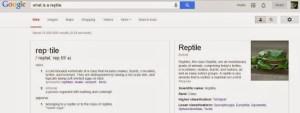
Here’s a screenshot of what they saw …
 |
| Google and the Google logo are registered trademarks of Google Inc., used with permission |
Can you see it yet? If not, look carefully at the picture and then the search terms.
The student had been looking for the definition of a reptile and up popped a picture of a frog … an amphibian.
The thing is, this is exactly what we want. We want students that can identify when something is wrong. Students that can see the internet as a tool, not the source of all knowledge. Students that can be interested in the mistakes they see out in the world and help figure out a way to correct them.
For my students, I had every intention of using this as a great lesson. When I got home, I quickly took the above screenshot and then provided feedback to Google about the error (which if you’ve never done it, it’s really easy). I figured each class could submit their own feedback throughout the day, which I hoped would be enough evidence for Google to switch out the image.However, I completely underestimated the power of Google. Less than twelve hours later, the image was fixed. We worked through the process anyway, which has catapulted them into a mission of mistake-finding since then. We’ve found errors in educational software, online textbooks, labs I’ve created, journal articles, educational videos and a wall quote that I put up at the start of second semester … just to name a few.
 Katie Budrow